

55.7K
Downloads
119
Episodes
The Future of Internal Communication podcast is a series commissioned by The Institute of Internal Communication.
Organisations today face widespread and continuous disruption. The way communication takes place within and across teams, departments and business units is more critical than ever.
The podcast hosts subject matter experts from within and outside internal communication, each sharing their insights on the future of work and the role of communication as an essential driver of workplace trust, connection, culture, innovation, resilience and performance.
Hosts Jennifer Sproul, Dominic Walters and Cat Barnard explore opportunity for internal communicators. In increasingly digital, data driven, distributed and on-demand work landscapes, their conversations with thought-leaders examine the human side of work.
Hosted by the IOIC's CEO, Jennifer Sproul, leadership communication expert, Dominic Walters, and future of work expert Cathryn Barnard, each episode explores the impact of the future of work on internal communication.
This podcast examines the human side and focuses on communication as a vital building block of connection and belonging. As colleagues and teams become increasingly distributed and on-demand, the skill of maintaining community and cohesion at work is critical.
Most importantly, this podcast dives into the future of internal communication and the expanding opportunity for the profession as a whole.
Episodes
May 28, 2025
May 28, 2025
46 min
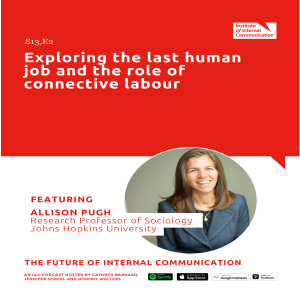
Since the public launch of ChatGPT in late 2022, scarcely a day goes by without a news headline forewarning of mass redundancies caused by technological efficiency.
But aren’t there some jobs or vocations where, no matter how sophisticated technology becomes, it simply won’t be able to replicate human empathy, reason and oversight?
In this episode Cat, Jen and Dom chat with sociology Professor Allison Pugh of John Hopkins University, drawing on her book The Last Human Job. They examine the role of connective labour and empathic communication in building goodwill, trust, mutuality and human connection, never more urgently needed in workplaces across the board.
About Allison Pugh
Allison Pugh is Research Professor of Sociology at Johns Hopkins University, and the author of four books, most recently The Last Human Job: The Work of Connecting in a Disconnected World (Princeton 2024). The 2024-5 Vice President of the American Sociological Association, Pugh has given more than 100 invited talks and has had visiting appointments in Australia, France and Germany. She is a former journalist, and her writing has appeared in The New Yorker, The New York Times, and other outlets. Pugh has served as a US diplomat in Honduras, cofounded an elementary school in California, waited on tables at the US Tennis Open and was an intern at Ms. Magazine. She and her husband have three children and live in Washington DC.
Find Allison on LinkedIn: https://www.linkedin.com/in/allison-pugh-b6169467/
Allison’s website: https://www.allisonpugh.com/
May 14, 2025
May 14, 2025
37 min
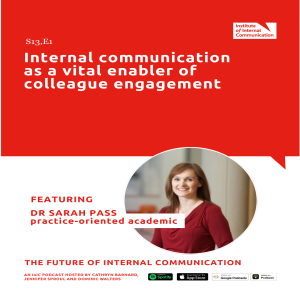
Since the MacLeod report was first published in 2009, Engage for Success (EFS) has become a flourishing all-volunteer collective for those passionate about colleague engagement.
A senior lecturer at Nottingham Business School, Dr. Sarah Pass is a practice-oriented academic who concentrates on employee experience and engagement. As a member of the Engage for Success (EFS) Advisory Board, she co-leads the EFS annual survey, which benchmarks the engagement levels of the UK working population.
In this episode, Sarah and Jen discuss the findings of the latest EFS survey, explore the four enablers of engagement and dig into why colleague voice is so important when seeking to build motivation and goodwill at work.
About Dr Sarah Pass
Dr Sarah Pass is a practice-oriented academic who concentrates on employee experience and engagement. She is a member of the Engage for Success (EFS) Advisory Board and co-leads the EFS annual survey, which benchmarks the engagement levels of the UK working population. Sarah leads EFS projects focusing on different aspects and influences of engagement in practice and is also Chair of the EFS East Midlands Area Network.
Sarah is a Fellow of the RSA, an Academic Associate of the CIPD, and a member of the Involvement and Participation Association (IPA) Working Insights Group. In 2023, Sarah was ranked by HR Magazine as an Influential Thinker in HR. Sarah currently works as a Senior Lecturer at Nottingham Business School (NTU).
Find Sarah on LinkedIn: https://www.linkedin.com/in/sarahpass/
Sarah at Nottingham Business School: https://www.ntu.ac.uk/staff-profiles/business/sarah-pass
Engage for Success: https://engageforsuccess.org/
Apr 16, 2025
Apr 16, 2025
48 min
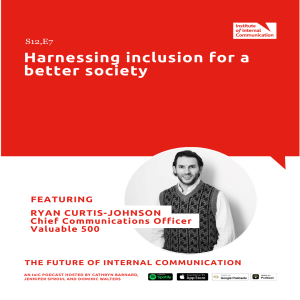
In 2025, workplace inclusion remains a key issue for the UK labour market. In summer 2024, the ONS reported the highest number of economically inactive people since 2012. While this label includes students and the retired, it more worryingly includes those who are unable to access the labour market due to either ill health or accessibility issues.
As the working population across the Global North declines, access to employment opportunity is a social and economic issue. But too many modern workplaces are too slow redesign their hiring and employment processes to maximise inclusivity.
In this episode, Dom, Jen and Cat chat with Ryan Curtis-Johnson from the Valuable500. He explains why inclusion is such a critical issue, not least when neurodivergence is on the rise. This conversation explores the opportunity for internal communication to create work cultures that boost diversity for enhanced organisational resilience.
Takeaways
- Inclusion is essential for a better society.
- The Valuable 500 aims to end disability exclusion.
- Businesses must navigate the fear of discussing disability.
- What's good for business is good for society.
- Inclusion should be embedded in all business practices.
- Neurodivergent individuals can bring unique strengths to the workplace.
- Organisations need to be flexible and inclusive in their policies.
- Diversity in problem-solving leads to better outcomes.
- Internal communication plays a crucial role in promoting inclusion.
- Sharing resources and knowledge fosters collaboration in inclusion efforts. Sharing best practices fosters inclusivity and learning.
- Disability should be embraced, not feared.
- Inclusion must be inherent in organisational behavior.
- Internal communicators play a vital role in promoting accessibility.
- Training on accessibility is essential for all employees.
- Care in communication can address societal challenges.
- Celebrating diversity can change negative perceptions.
- All employees should be allies for inclusivity.
- Inclusivity is a long journey that requires commitment.
+++++
Find Ryan on LinkedIn: https://www.linkedin.com/in/ryan-curtis-johnson-b2233330/
The Valuable 500: https://www.thevaluable500.com/
Apr 2, 2025
Apr 2, 2025
1 hr 2 min
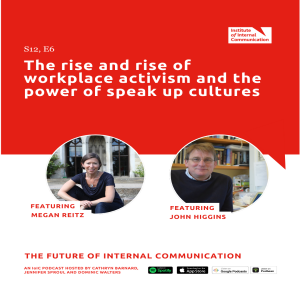
With so many pressing environmental and social challenges to address, workplace activism is on the rise. Concerned citizens are increasingly using whatever means they have – whether as consumers, shareholders, or increasingly now, workers – to raise awareness and effect change for the issues that matter to them.
This has dynamic consequences for business. Organisations must work out how best to respond to colleagues who bring social and environmental justice issues to work. Those that refuse to listen to the concerns of their staff face disengagement, or worse, mutiny.
How can – and should - leaders shift from traditionally hierarchical ways of thinking about the views and opinions of their workers towards leveraging and integrating those views for the benefit of all?
In this episode, Jen, Dom and Cat speak to Megan Reitz and John Higgins, co-authors of Speak Up: Say What Needs to be Said and Hear What Needs to be Heard. They explore the role of colleague voice in engagement and look at the role of internal communication in helping organisations become better equipped to hear – and leverage – the views that matter.
+++++
Find Megan on LinkedIn: https://www.linkedin.com/in/meganreitz/
Megan’s website: https://www.meganreitz.com/
John’s website: http://www.johnhigginsresearch.com
Mar 19, 2025
Mar 19, 2025
41 min
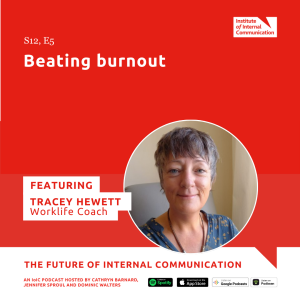
According to Mental Health UK, 90% of adults experienced high or extreme levels of stress in 2023, a figure that was consistent across all ages. The same research found 20% of people of working age needed to take time off due to poor mental health.
In 2025, there are all manner of reasons why people are anxious, stressed and close to burnout. The way we work isn’t working for far too many of us.
But what are the signs of burnout and what support is available? What can organisations do to help colleagues better manage their workloads? And what part can internal communication play?
In this episode, Jen, Cat and Dom chat with Tracey Hewett, a worklife coach and wellbeing trainer to understand the risks and how to avoid them.
Takeaways
- Burnout has been on the rise since the pandemic.
- Work-related stress is a significant issue affecting many employees.
- The World Health Organisation defines burnout as a syndrome from chronic workplace stress.
- Leisure activities are essential for recovery and should not be overlooked.
- Learning to say no is a powerful tool for managing workload.
- Organisations have a legal duty to ensure psychological health.
- Effective communication is key to alleviating burnout.
- Internal communicators can model supportive behaviours in the workplace.
- Recognising the signs of burnout is crucial for prevention.
- Self-care is essential for maintaining wellbeing in high-pressure environments.
+++++
Find Tracey on LinkedIn: https://www.linkedin.com/in/traceyhewett/
Worklife Mindfulness: https://www.worklifemindfulness.com/
HSE - employer’s legal duty: https://www.hse.gov.uk/stress/overview.htm
Tracey’s stress audit: https://www.worklifemindfulness.com/work-related-stress-audit
Tracey’s blog about burnout: 19 things I learned from a stay at Burnout Hotel
https://www.worklifemindfulness.com/post/things-i-learned-from-burnout
Mar 5, 2025
Mar 5, 2025
51 min
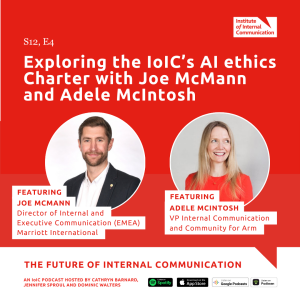
In February 2025, the IoIC launched its AI ethics Charter for internal communication. As GenerativeAI adoption goes mainstream, there are many moral and ethical considerations that require contemplation and resolution. Its implementation requires human care, stewardship and oversight.
The goal of the AI Charter is to present some of the most pressing points for organisations to reflect and agree on and to catalyse a live and ongoing membership conversation about how best to adopt AI while sustaining access to good, purposeful work for colleagues.
In this conversation, we are joined by AI taskforce members Adele McIntosh and Joe McMann. As VP Internal Communication and Community for Arm (Adele) and Director of Internal and Executive Communication (EMEA) for Marriott International (Joe), they were expertly placed to help evaluate what an AI ethics Charter might include. We discuss what drew them to the taskforce and the role internal communication can play in helping organisations harness the full potential of AI.
Takeaways
- AI is a significant part of organisational development.
- The AI Ethics Charter aims to address ethical and human-centered AI adoption.
- Internal communicators play a crucial role in AI integration.
- The charter will evolve as technology progresses.
- AI presents both risks and opportunities for organizations.
- Community building is essential in navigating AI challenges.
- Transparency and ethics are vital in AI communication.
- Understanding AI's impact on jobs is crucial for employee engagement.
- Internal communication can help demystify AI for employees.
- A strategic narrative around AI is necessary for effective communication. AI presents a significant opportunity for internal communicators.
- Maintaining human connection is crucial in the age of AI.
- The roles of communicators will evolve with AI integration.
- Authenticity and trust may be at risk with automation.
- Organizations must embrace AI to thrive in the future.
- Disengagement and loneliness are pressing issues in communication.
- AI can enhance efficiency but should not replace human insight.
- Ethical considerations are paramount in AI adoption.
- Communication about AI is essential to mitigate risks.
- Continuous learning and adaptation are necessary for success.
+++++
Find Adele on LinkedIn: https://www.linkedin.com/in/adelekmcintosh/
Find Joe on LinkedIn: https://www.linkedin.com/in/joe-mcmann-364a1b11/
Download the AI ethics Charter
Feb 19, 2025
Feb 19, 2025
53 min
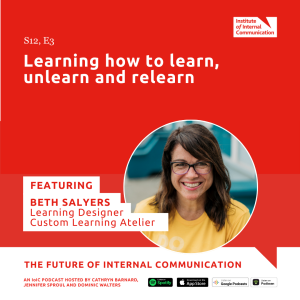
AI and associated technologies are changing the work people do and the way business gets done. As work becomes increasingly digital, scant few of us can remain complacent with our current skills and expertise – we must all upskill to remain relevant and future-ready.
This raises interesting questions. We are rapidly shifting away from an era where organisations trained their staff for efficiency and compliance. Instead, we must all become continuous learners – learning in the flow of work we do each day. Simply put, the skills that upheld business as usual up until now are no longer sufficient to navigate today’s challenges.
In this episode Cat, Jen and Dom chat with learning designer Beth Salyers to understand how we best learn and, more poignantly, what role communication plays in social learning.
Takeaways
- Continuous learning should be integrated into daily work.
- Traditional education models are outdated and need rethinking.
- Identity plays a crucial role in how we learn.
- Creating safe spaces is essential for effective learning.
- Learning experiences should be designed for engagement.
- Trusting learners is key to fostering a learning culture.
- Curiosity should drive our approach to learning.
- Organizations must meet learners where they are.
- Engagement is critical for effective learning outcomes.
- Reluctant learners can be engaged through shared agendas. Meeting people where they are is essential for effective communication.
- Engagement in learning is often a challenge due to preconceived notions.
- Curiosity is a key driver for meaningful learning experiences.
- Continuous learning should be integrated into the fabric of organisations.
- The focus should shift from skills to capabilities in learning design.
- Learning is inherently social and should be treated as such.
- Organisations must navigate the future of work with a focus on empathy and understanding.
- Internal communicators play a crucial role in facilitating learning.
- Communication strategies should guide and support continuous learning.
- A collaborative approach between L&D and internal communication is vital.
About Beth Salyers
Beth Salyers, Ph.D. is a former public school classroom teacher and current learning experience designer for social impact organisations, including for-profits, nonprofits, and schools and universities through her consulting business, Custom Learning Atelier. She knows herself and the world first and foremost through the arts and music, is a practitioner of human-centered circular design thinking methodologies, and a big soccer fan. In 2025 she's embarking on an external-facing personal creative project called #CuriosityTour2025 as a way to regeneratively navigate (another trump administration) whatever in the hell is happening in the U.S. right now. (thought I'd make you laugh).
Feb 5, 2025
Feb 5, 2025
48 min
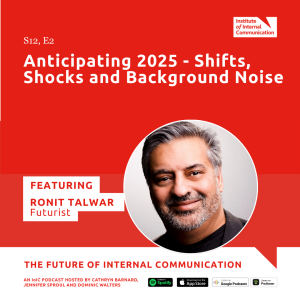
As we enter another year of instability and uncertainty, it behoves all organisations to keep one eye on the future for successful innovation and evolution. But shifting out of survival mode to examine the long game remains a challenge for many.
Horizon scanning and scenario planning to mitigate risk and leverage opportunity ought to be in every business strategist’s toolkit. However, all too often boards and senior leadership teams are stressed and overwhelmed by firefighting and conflicting priorities.
What are the benefits of future-gazing? In this episode, Dom, Jen and Cat chat with IoIC festival keynote speaker Rohit Talwar. They explore some underlying trends that are set to reshape business in 2025 and look at how can internal communicators help their organisations become more future-ready.
Takeaways
- Futurists explore trends and shifts rather than predict the future.
- Organisations need to develop agile and adaptive mindsets.
- AI is a significant force that organisations must engage with.
- Large corporations often struggle with transformation due to their size and conservatism.
- The SME community is more focused on future-proofing their operations.
- Cultural shifts in attitudes towards work are changing organisational dynamics.
- The rise of generative AI is reshaping how businesses operate.
- Effective communication is crucial for fostering a learning culture.
- Organisations must prepare for uncharted territories and unknown unknowns.
- Budget constraints may impact internal communication and training initiatives. The demand for GenAIi prompts is increasing among professionals.
- Organisations must navigate the triangle of human challenges, tech opportunities, and financial pressures.
- Forming alliances with key stakeholders is essential for internal communicators.
- Spotting and promoting mindset shifts can drive innovation.
- Internal communicators should connect employees with organisational changes and external trends.
- Continuous learning is vital for personal and organisational growth.
- No one cares more about your future than you do.
- Learning helps combat fear and confusion in a complex world.
- Internal communication must adapt to the changing landscape of work.
- Highlighting successful examples of innovation can inspire others.
About Rohit Talwar
Rohit Talwar is a global futurist, award-winning keynote speaker, author, and the CEO of Fast Future. He has a particular focus on helping clients develop ‘ready for anything’ leadership mindsets and capabilities to understand and respond to critical forces and developments shaping the future – ranging from geo-political and economic shifts through to sustainability and disruptive technologies such as AI. His keynote speeches and immersive executive education sessions are all highly tailored to the needs and context of the client organisation.
His key current speaking topics include:
- Global forces, shifts, and disruptions shaping the future
- Futureproofing - developing ‘ready for anything’ leadership
- The AI stepchange – accelerating insight, capability, and performance with AI.
Rohit has advised over 2,000 clients in global businesses, technology providers, professional service firms, governments, international agencies, NGO’s, and industry associations across a wide range of sectors in 80+ countries around the world. He uses his insights, experience, and inspirations to help clients build sustainable and future proofed organisations through virtual and in person speaking, executive education, research, consultancy, and publishing.
Fast Future www.fastfuture.com
Fast Future is a foresight agency led by futurist Rohit Talwar with a prime focus on helping clients explore and prepare for future shifts and uncertainties. Key services include keynote speaking, executive education, foresight research, scenario planning, strategy consultancy, event design and book publishing. Critical themes covered include leading in uncertainty, disruptive technologies such as AI, innovation and new business models, global shifts and shocks, new economic thinking, socio-demographic developments, sustainability, and the environment. Fast Future has published seven books and over 20 reports on different aspects of the emerging future.
Find Rohit on LinkedIn: https://www.linkedin.com/in/rohit-talwar-futurist-keynote-speaker/
Fast Future: https://fastfuture.com/
Jan 22, 2025
Jan 22, 2025
48 min
Have we shifted from polycrisis to permacrisis? As geopolitical tensions, extreme weather events and societal discord show no sign of abate, the pressure builds for organisations to end unsustainable business practices and reduce carbon emissions. In addition to regulatory demands, a rising tide of employee activists expect business to act as a force for good.
Organisational purpose seems to have become a misappropriated buzzword in recent years, one that all-too-often lacks depth and resonance.
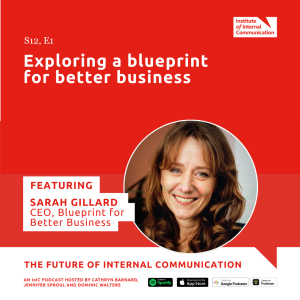
What part can and should business play in a more equitable, well-functioning society and what role can internal communication play in bringing that to life? In this episode Jen, Dom and Cat talk with Sarah Gillard, CEO of the charity Blueprint for Better Business to hear her views on the opportunity for business to address the pressing challenges of our times.
Takeaways
- The role of business is to create value for society.
- Profit should be an outcome, not the primary goal.
- Human beings have inherent value and dignity.
- Organisations must create conditions for meaningful engagement.
- Navigating business decisions requires listening to diverse perspectives.
- Purpose and values must resonate with all employees, not just leadership.
- A human-centric approach unlocks creativity and innovation.
- Business leaders face a complex and contested landscape today.
- Engagement should not be imposed but discovered collectively.
- Rethinking purpose can lead to more authentic organisational cultures. Intent is crucial in how employees perceive organisational initiatives.
- Transparency in decision-making fosters trust and engagement.
- Organisations must shift from efficiency to adaptability to thrive.
- Communication plays a vital role in shaping organisational culture.
- Fear can stifle creativity; a growth mindset is essential.
- Finding meaning in work enhances motivation and engagement.
- Leaders should focus on what matters to them as humans.
- Building a listening organisation is key to internal communication.
- The future of work requires new skills and adaptability.
- Shared humanity can unite people in organisations.
About Sarah Gillard
Sarah is the CEO of Blueprint for Better Business, a charity that helps businesses to be inspired and guided by a purpose that benefits society and respects people and planet. She is a passionate advocate for making business “more human” - places where people flourish, communities prosper, and long-term sustainability is the driving force. She has over 25 years’ experience leading in fast-paced commercial environments at some of the UK’s largest retail companies, including the John Lewis Partnership where she was responsible for rearticulating and embedding the organisation’s purpose so that it continues to be a source of inspiration, innovation, and strategic differentiation.
Sarah has a degree in PPE, is a fellow of the RSA and a Trustee of the BGF Foundation. She is a member of the Advisory Panel for the British Standards Institute on “PAS 808: a standard for purpose-driven organization”, which is being developed into an internationally-recognised ISO. Sarah is a qualified executive coach and speaks publicly on topics including purpose, leadership, organisational transformation and culture.
Find Sarah on LinkedIn: https://www.linkedin.com/in/sarahgillardpurpose/
Blueprint for Better Business: https://www.blueprintforbusiness.org/

Jan 15, 2025
Jan 15, 2025
32 min
In this first episode of 2025, Jen, Dom and Cat review their favourite conversations of 2024. They also discuss the topics, trends and themes they most want to explore in 2025, as shaped by what IoIC members have said they want to learn more about.
This episode explores some of the primary risks and opportunities for internal communicators in the coming year. Tune in to hear about up and coming guests and conversations.
Follow on LinkedIn